
By Mir Asif Hussain
The connection between environment and economy has never been clearer. When we pollute, deforest, and build without planning, nature responds with unpredictable extremes. These extremes do not only disrupt our surroundings—they strike at the heart of our economy. Nowhere is this more visible than in Jammu and Kashmir, where apple growers are paying the heaviest price.
For the past ten days, continuous heavy rainfall has thrown life out of gear across the Valley. For the common person, it has meant waterlogging, landslides, and disrupted travel. But for apple growers, it has been a disaster. This is the critical time of harvesting, when fruit should have been picked, packed, and sent to markets across India. Instead, orchards remain soaked, fruit is dropping prematurely, and entire crops risk rotting on the trees.
Apple cultivation is not just a seasonal occupation—it is the backbone of Kashmir’s economy, supporting more than three million people directly or indirectly. Losses in this sector ripple far and wide. A poor harvest or delayed transportation affects traders, transporters, laborers, and ultimately consumers in cities who depend on Kashmiri apples.
The situation has been made worse by the frequent closure of the Jammu–Srinagar National Highway. Landslides triggered by the rains have stranded trucks loaded with apples for days. By the time the produce reaches markets, much of it is spoiled, fetching poor returns. For farmers who invest heavily throughout the year—on fertilizers, pesticides, packaging, and labor—this means devastating financial losses.
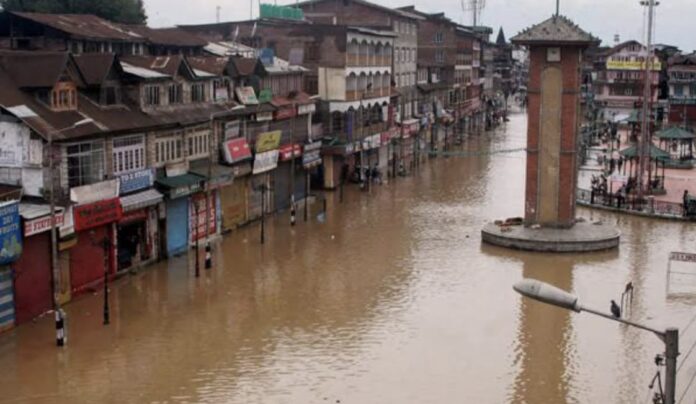
This year’s crisis echoes the painful memories of the 2014 floods, one of the worst natural disasters in Kashmir’s history. In September 2014, relentless rains swelled the Jhelum and submerged vast stretches of Srinagar and the surrounding districts. Entire villages were marooned, crops washed away, and orchards destroyed. Farmers lost not just their seasonal produce but also the very foundations of their livelihoods: their trees, homes, and cattle. The floods pushed thousands of families deeper into poverty, with many unable to recover even after years. Small businesses collapsed, educational institutions remained shut for months, and healthcare services were paralyzed. The scars of that devastation still linger in collective memory, serving as a grim warning of what unchecked environmental degradation can unleash.

