
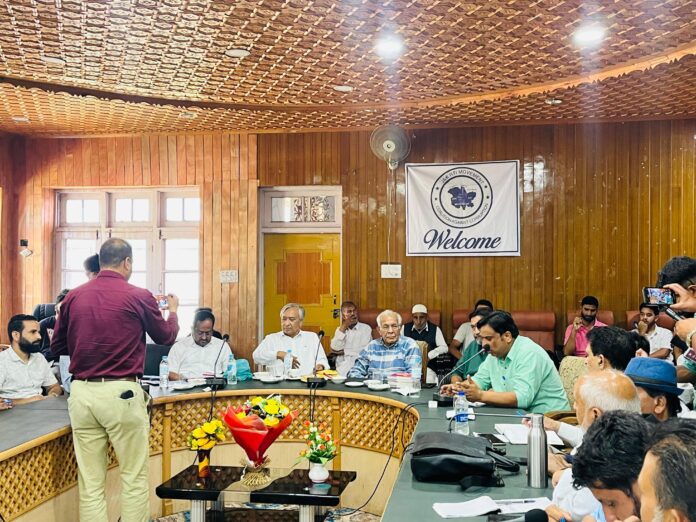
Citizens in Jammu and Kashmir have as much right to seek information from the government as people elsewhere in the country, even though the Central Right to Information Act, 2005, is not as robust as the erstwhile J&K RTI Act, 2009, said Mr. Wajahat Habibullah, India’s first Chief Information Commissioner.
Addressing over 200 participants from civil society and local self-governing bodies at a sensitisation programme in Kulgam on Friday, Mr. Habibullah, who also chairs the Delhi-based Commonwealth Human Rights Initiative (CHRI), encouraged people not to lose hope. “The RTI Act exists to address grievances and enhance transparency and accountability. Citizens must make full use of this tool,” he said.
The seminar was jointly organised by the J&K RTI Movement, CHRI, and civil society members of Kulgam.
Presiding over the event, CPI(M) leader and Kulgam MLA Mr. Mohammad Yousuf Tarigami underscored the importance of asking questions and seeking information from public authorities, saying such acts are the very foundation of accountable governance.
“Demanding answers is not an act of anarchy,” Mr. Tarigami said. “RTI is not about levelling allegations or abusing officials. It is about fostering trust between citizens and the administration.” He added that fears about RTI weakening governance have proven unfounded and that the law is more essential now than ever before.
Highlighting gaps in administrative transparency, Mr. Tarigami noted that rules of government business have yet to be made public even eight months after the formation of the elected government. “Even officials seem unsure of the decision-making process,” he remarked wryly. He also flagged delays in processing applications for social welfare schemes such as pensions for widows and the elderly, saying citizens deserve clarity on such matters.
Dr. Shaikh Ghulam Rasool, Founder-Chairperson of the J&K RTI Movement, offered an overview of the RTI campaign in the region. He recalled that Mr. Tarigami had introduced a private member’s bill on RTI in 2008 and lauded Mr. Habibullah’s role in persuading the then J&K government to adopt a law aligned with the Central RTI Act in 2009.
“The RTI law is not just about accessing files; it is about reshaping the citizen-state relationship,” said Dr. Rasool. “In Kashmir—where silence often prevails—today’s event sent a clear message: we are watching, we are asking, and we have the right to know.”
Venkatesh Nayak, Director of CHRI, spoke about a recent workshop in Srinagar where law students and young advocates drafted RTI applications focused on local governance issues. “If the youth are so engaged, there’s no reason for citizens in Kulgam to hesitate,” he said. He highlighted the utility of the J&K RTI portal, which allows citizens to file applications and attend second appeal hearings via video conference.
Mr. Mohammad Abbas, DDC Member, Kulgam, welcomed participants and expressed hope that the revived partnership between CHRI and the J&K RTI Movement would reinvigorate the region’s transparency efforts. Chairperson of the DDC, Mr. Mohammad Afzal Parray, delivered the vote of thanks, expressing optimism that the initiative would pave the way for more responsive governance in the district.

